etsy/phan
Composer 安装命令:
composer create-project etsy/phan
包简介
A static analyzer for PHP
README 文档
README
Phan is a static analyzer for PHP that prefers to minimize false-positives. Phan attempts to prove incorrectness rather than correctness.
Phan looks for common issues and will verify type compatibility on various operations when type information is available or can be deduced. Phan has a good (but not comprehensive) understanding of flow control and can track values in a few use cases (e.g. arrays, integers, and strings).

Getting Started
The easiest way to use Phan is via Composer.
composer require phan/phan
With Phan installed, you can start analyzing your code immediately! Phan includes built-in stubs for enhanced type checking of PHP extensions.
For new projects, use phan --init to create a .phan/config.php file with recommended settings and bundled stubs. You can also manually create a config file if you prefer. Once configured, you can run it via ./vendor/bin/phan.
Phan 6 requires PHP 8.1+ with the php-ast extension (1.1.3+ is required for PHP 8.4+ support) and supports analyzing PHP version 8.1-8.5 syntax.
Installation instructions for php-ast can be found here.
(Phan can be used without php-ast by using the CLI option --allow-polyfill-parser, but there are slight differences in the parsing of doc comments)
- Alternative Installation Methods
See Getting Started for alternative methods of using Phan and details on how to configure Phan for your project. - Incrementally Strengthening Analysis
Take a look at Incrementally Strengthening Analysis for some tips on how to slowly ramp up the strictness of the analysis as your code becomes better equipped to be analyzed. - Installing Dependencies
Take a look at Installing Phan Dependencies for help getting Phan's dependencies installed on your system.
The Wiki has more information about using Phan.
Tolerant parser dependency
Phan relies on phan/phan-tolerant for the fallback parser and language-server mapping. The project is now consumed as a Composer dependency (microsoft/tolerant-php-parser, overridden to our fork via the repository entry in composer.json) rather than via a vendored subtree.
To run the tolerant parser’s own PHPUnit suites, install its dev dependencies and invoke PHPUnit from the dependency directory:
composer install
cd vendor/microsoft/tolerant-php-parser
composer install
php -d zend.assertions=1 -d assert.exception=1 vendor/bin/phpunit --testsuite invariants,api
When you need to refresh the parser to a newer commit, adjust the constraint in composer.json (or run composer update microsoft/tolerant-php-parser) and commit the resulting lockfile change.
Features
Phan is able to perform the following kinds of analysis:
- Check that all methods, functions, classes, traits, interfaces, constants, properties and variables are defined and accessible.
- Check for type safety and arity issues on method/function/closure calls.
- Check for PHP 8.5/8.4/8.3/8.2/8.1 backward compatibility.
- Check for features that weren't supported in older PHP 8.x minor releases (E.g. property hooks,
readonlyclasses, enums, union types, match expressions, etc.) - Check for sanity with array accesses.
- Check for type safety on binary operations.
- Check for valid and type safe return values on methods, functions, and closures.
- Check for No-Ops on arrays, closures, constants, properties, variables, unary operators, and binary operators.
- Check for unused/dead/unreachable code. (Pass in
--dead-code-detection) - Check for unused variables and parameters. (Pass in
--unused-variable-detection) - Check for redundant or impossible conditions and pointless casts. (Pass in
--redundant-condition-detection) - Check for unused
usestatements. These and a few other issue types can be automatically fixed with--automatic-fix. - Check for classes, functions and methods being redefined.
- Check for sanity with class inheritance (e.g. checks method signature compatibility). Phan also checks for final classes/methods being overridden, that abstract methods are implemented, and that the implemented interface is really an interface (and so on).
- Supports namespaces, traits and variadics.
- Supports Union Types.
- Supports Generic Types (i.e.
@template). - Supports generic arrays such as
int[],UserObject[],array<int,UserObject>, etc.. - Supports array shapes such as
array{key:string,otherKey:?stdClass}, etc. (internally and in PHPDoc tags) This also supports indicating that fields of an array shape are optional viaarray{requiredKey:string,optionalKey?:string}(useful for@param). Multi-line forms of@param,@var, and@returnannotations are normalized before being parsed, so docblocks can format nested arrays/generics over several lines. - Supports phpdoc type annotations.
- Supports inheriting phpdoc type annotations.
- Supports checking that phpdoc type annotations are a narrowed form (E.g. subclasses/subtypes) of the real type signatures
- Supports inferring types from assert() statements and conditionals in if elements/loops.
- Supports
@deprecatedannotation for deprecating classes, methods and functions - Supports
@internalannotation for elements (such as a constant, function, class, class constant, property or method) as internal to the package in which it's defined. - Supports
@suppress <ISSUE_TYPE>annotations for suppressing issues. - Supports magic @property annotations (
@property <union_type> <variable_name>) - Supports magic @method annotations (
@method <union_type> <method_name>(<union_type> <param1_name>)) - Supports
class_aliasannotations (experimental, off by default) - Supports indicating the class to which a closure will be bound, via
@phan-closure-scope(example) - Supports analysis of closures and return types passed to
array_map,array_filter, and other internal array functions. - Offers extensive configuration for weakening the analysis to make it useful on large sloppy code bases
- Can be run on many cores. (requires
pcntl) - Output is emitted in text, checkstyle, json, pylint, csv, codeclimate, html, or github formats.
- Can run user plugins on source for checks specific to your code. Phan includes various plugins you may wish to enable for your project.
See Phan Issue Types for descriptions and examples of all issues that can be detected by Phan. Take a look at the \Phan\Issue to see the definition of each error type.
Take a look at the Tutorial for Analyzing a Large Sloppy Code Base to get a sense of what the process of doing ongoing analysis might look like for you.
Phan can be used from various editors and IDEs for its error checking, "go to definition" support, etc. via the Language Server Protocol. Editors and tools can also request analysis of individual files in a project using the simpler Daemon Mode.
See the tests directory for some examples of the various checks.
Phan is imperfect and shouldn't be used to prove that your PHP-based rocket guidance system is free of defects.
Features provided by plugins
Additional analysis features have been provided by plugins.
- Checking for syntactically unreachable statements (E.g.
{ throw new Exception("Message"); return $value; }) - Checking
*printf()format strings against the provided arguments (as well as checking for common errors) - Checking that PCRE regexes passed to
preg_*()are valid - Checking for
@suppressannotations that are no longer needed. - Checking for duplicate or missing array keys.
- Checking coding style conventions
- Others
Example: Phan's plugins for self-analysis.
Usage
After installing Phan, Phan needs to be configured with details on where to find code to analyze and how to analyze it. The
easiest way to tell Phan where to find source code is to create a .phan/config.php file.
A simple .phan/config.php file might look something like the following.
<?php

/**
 * This configuration will be read and overlaid on top of the
 * default configuration. Command line arguments will be applied
 * after this file is read.
 */
return [

    // Supported values: `'8.1'`, `'8.2'`, `'8.3'`, `'8.4'`, `'8.5'`, `null`.
    // If this is set to `null`,
    // then Phan assumes the PHP version which is closest to the minor version
    // of the php executable used to execute Phan.
    "target_php_version" => null,

    // A list of directories that should be parsed for class and
    // method information. After excluding the directories
    // defined in exclude_analysis_directory_list, the remaining
    // files will be statically analyzed for errors.
    //
    // Thus, both first-party and third-party code being used by
    // your application should be included in this list.
    'directory_list' => [
        'src',
        'vendor/symfony/console',
    ],

    // A directory list that defines files that will be excluded
    // from static analysis, but whose class and method
    // information should be included.
    //
    // Generally, you'll want to include the directories for
    // third-party code (such as "vendor/") in this list.
    //
    // n.b.: If you'd like to parse but not analyze 3rd
    //       party code, directories containing that code
    //       should be added to the `directory_list` as
    //       to `exclude_analysis_directory_list`.
    "exclude_analysis_directory_list" => [
        'vendor/'
    ],

    // A list of plugin files to execute.
    // Plugins which are bundled with Phan can be added here by providing their name
    // (e.g. 'AlwaysReturnPlugin')
    //
    // Documentation about available bundled plugins can be found
    // at https://github.com/phan/phan/tree/v6/.phan/plugins
    //
    // Alternately, you can pass in the full path to a PHP file
    // with the plugin's implementation.
    // (e.g. 'vendor/phan/phan/.phan/plugins/AlwaysReturnPlugin.php')
    'plugins' => [
        // checks if a function, closure or method unconditionally returns.
        // can also be written as 'vendor/phan/phan/.phan/plugins/AlwaysReturnPlugin.php'
        'AlwaysReturnPlugin',
        'DollarDollarPlugin',
        'DuplicateArrayKeyPlugin',
        'DuplicateExpressionPlugin',
        'PregRegexCheckerPlugin',
        'PrintfCheckerPlugin',
        'SleepCheckerPlugin',
        // Checks for syntactically unreachable statements in
        // the global scope or function bodies.
        'UnreachableCodePlugin',
        'UseReturnValuePlugin',
        'EmptyStatementListPlugin',
        'LoopVariableReusePlugin',
    ],
];
Take a look at Creating a Config File and Incrementally Strengthening Analysis for more details.
Running phan --help will show usage information and command-line options.
Annotating Your Source Code
Phan reads and understands most PHPDoc
type annotations including Union Types
(like int|MyClass|string|null) and generic array types (like int[] or string[]|MyClass[] or array<int,MyClass>).
Take a look at Annotating Your Source Code and About Union Types for some help getting started with defining types in your code.
Phan supports (int|string)[] style annotations, and represents them internally as int[]|string[]
(Both annotations are treated like array which may have integers and/or strings).
When you have arrays of mixed types, just use array.
The following code shows off the various annotations that are supported.
/**
 * @return void
 */
function f() {}

/** @deprecated */
class C {
    /** @var int */
    const C = 42;

    /** @var string[]|null */
    public $p = null;

    /**
     * @param int|null $p
     * @return string[]|null
     */
    public static function f($p) {
        if (is_null($p)) {
            return null;
        }

        return array_map(
            /** @param int $i */
            function($i) {
                return "thing $i";
            },
            range(0, $p)
        );
    }
}
Just like in PHP, any type can be nulled in the function declaration which also means a null is allowed to be passed in for that parameter.
Phan checks the type of every single element of arrays (Including keys and values).
In practical terms, this means that [$int1=>$int2,$int3=>$int4,$int5=>$str6] is seen as array<int,int|string>,
which Phan represents as array<int,int>|array<int,string>.
[$strKey => new MyClass(), $strKey2 => $unknown] will be represented as
array<string,MyClass>|array<string,mixed>.
- Literals such as
[12,'myString']will be represented internally as array shapes such asarray{0:12,1:'myString'}
Generating a file list
This static analyzer does not track includes or try to figure out autoloader magic. It treats
all the files you throw at it as one big application. For code encapsulated in classes this
works well. For code running in the global scope it gets a bit tricky because order
matters. If you have an index.php including a file that sets a bunch of global variables and
you then try to access those after the include(...) in index.php the static analyzer won't
know anything about these.
In practical terms this simply means that you should put your entry points and any files
setting things in the global scope at the top of your file list. If you have a config.php
that sets global variables that everything else needs, then you should put that first in the list followed by your
various entry points, then all your library files containing your classes.
Development
Take a look at Developer's Guide to Phan for help getting started hacking on Phan.
When you find an issue, please take the time to create a tiny reproducing code snippet that illustrates
the bug. And once you have done that, fix it. Then turn your code snippet into a test and add it to
tests then ./test and send a PR with your fix and test. Alternatively, you can open an Issue with
details.
To run Phan's unit tests, just run ./test.
To run all of Phan's unit tests and integration tests, run ./tests/run_all_tests.sh
Code of Conduct
We are committed to fostering a welcoming community. Any participant and contributor is required to adhere to our Code of Conduct.
Online Demo
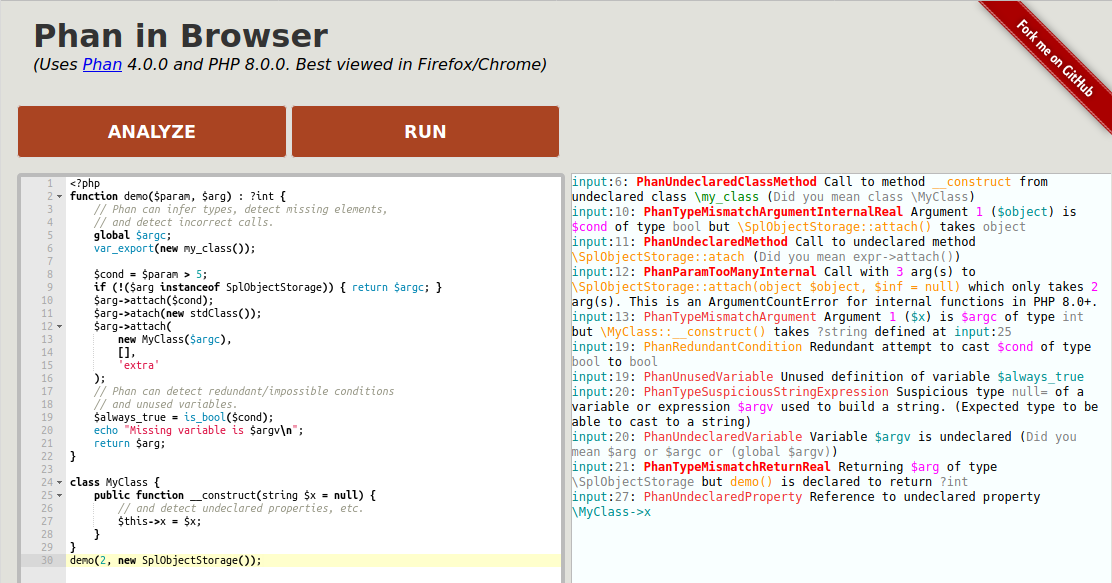
This requires an up to date version of Firefox/Chrome and at least 4 GB of free RAM. (this is a 15 MB download)
Run Phan entirely in your browser.
etsy/phan 适用场景与选型建议
etsy/phan 是一款 基于 PHP 开发的 Composer 扩展包,目前已累计 212.3k 次下载、GitHub Stars 达 5.62k, 最近一次更新时间为 2015 年 12 月 14 日, 在 PHP 生态内属于活跃度较高的组件。
它主要适用于以下技术方向: 「php」 「static」 「analyzer」 「static analysis」 等业务场景。在实际项目中,围绕这些方向常见需要落地的问题包括:接口对接、性能调优、并发安全、与既有框架(Laravel / ThinkPHP / Yii / Webman 等)的兼容适配,以及生产环境的日志埋点与稳定性保障。
我们在过去多个企业项目中使用过 etsy/phan 或与其功能相近的方案,如果你在选型或落地过程中遇到问题,例如 版本兼容、二次改造、私有化封装、与内部系统对接、生产 BUG 排查,欢迎联系我们协助评估。
基于 etsy/phan 在你已有业务上做功能扩展、字段裁剪、UI 适配、与内部账号 / 权限 / 日志系统的深度对接。
线上偶发问题、内存泄漏、慢查询、并发异常等排查修复;针对高流量场景做缓存、队列、索引层面的调优。
承接完整的项目从需求 → 设计 → 开发 → 上线 → 长期运维;也可按月提供技术保姆服务。
与 etsy/phan 相关的其它包
同方向 / 同关键字的高下载量 PHP Composer 包推荐,方便对比选型:
Bookdown.io With Bootswatch Styles And Prism Syntax Highlighting
Log analyzer widget for yii2
TwigStan is a static analyzer for Twig templates powered by PHPStan
Runtime analysis tool for Doctrine ORM integrated into Symfony Web Profiler. Unlike static linters, it analyzes actual query execution at runtime to detect performance bottlenecks, security vulnerabilities, and best practice violations during development with real execution context and data.
Phan plugins for Miraheze
Analyze queries generated by Prime ORM and dump unsafe or not optimized queries
统计信息
- 总下载量: 212.3k
- 月度下载量: 0
- 日度下载量: 0
- 收藏数: 5619
- 点击次数: 14
- 依赖项目数: 4
- 推荐数: 0
其他信息
- 授权协议: MIT
- 更新时间: 2015-12-14