fico7489/laravel-eloquent-join
Composer 安装命令:
composer require fico7489/laravel-eloquent-join
包简介
This package introduces the join magic for eloquent models and relations.
关键字:
README 文档
README

Laravel Eloquent Join
This package introduces the join magic for eloquent models and relations.
Introduction
Eloquent is a powerful ORM but its join capabilities are very poor.
First Eloquent Problem (sorting)
With laravel you can't perform sorting of the relationship fields without manually joining related table which is very awkward. Let me give you a few reasons why. If you have a table with posts and related categories your code might look like this:
$posts = Post::select('posts.*')
    ->join('categories', 'categories.id', '=', 'posts.category_id')
    ->groupBy('posts.id')
    ->where('categories.deleted_at', '=', null)
    ->orderBy('categories.name');

if(request()->get('date')){
    $posts->where('posts.date', $date)
}

$posts = $posts->get();
1.The first problem is that you need to worry about select.
->select('posts.*')
Reason : without select id from the category can be selected and hydrated into the Post model.
2.The second problem is that you need to worry about groupBy.
->groupBy('posts.id');
Reason : if the relation is HasOne and there are more than one categories for the post, the query will return more rows for categories.
3.The third problem is that you need to change all other where clauses from :
->where('date', $date)
to
->where('posts.date', $date)
Reason : a post and category can have "date" attribute and in that case without selecting an attribute with table "ambiguous column" error will be thrown.
4.The fourth problem is that you are using table names(not models) and this is also bad and awkward.
->where('posts.date', $date)
5.The fifth problem is that you need to worry about soft deletes for joined tables. If the category is using SoftDeletes trait you must add :
->where('categories.deleted_at', '=', null)
This package will take care of all above problems for you. Unlike sorting, you can perform filtering on the relationship fields without joining related tables, but this package will give you the ability to do this easier.
Second Eloquent Problem (subqueries)
With laravel you can perform where on the relationship attribute but laravel will generate subqueries which are more slower than joins. With this package you will be available to perform where on the relationship with joins in an elegant way.
Requirements
| Laravel Version | Package Tag | Supported | Development Branch |
|---|---|---|---|
| >= 5.5.0 | 4.* | yes | master |
| < 5.5.0 | - | no | - |
Package is also tested for SQLite, MySql and PostgreSql
Installation & setup
1.Install package with composer
composer require fico7489/laravel-eloquent-join
With this statement, a composer will install highest available package version for your current laravel version.
2.Use Fico7489\Laravel\EloquentJoin\Traits\EloquentJoinTrait trait in your base model or only in particular models.
...
use Fico7489\Laravel\EloquentJoin\Traits\EloquentJoin;
use Illuminate\Database\Eloquent\Model;

abstract class BaseModel extends Model
{
    use EloquentJoin;
...
3.IMPORTANT
For MySql make sure that strict configuration is set to false
config/database.php
        'mysql' => [
			...
            'strict'    => false,
			...
and that's it, you are ready to go.
Options
Options can be set in the model :
class Seller extends BaseModel
{
    protected $useTableAlias = false;
    protected $appendRelationsCount = false;
    protected $leftJoin = false;
    protected $aggregateMethod = 'MAX';
or on query :
    Order::setUseTableAlias(true)->get();
    Order::setAppendRelationsCount(true)->get();
    Order::setLeftJoin(true)->get();
    Order::setAggregateMethod(true)->get();
useTableAlias
Should we use an alias for joined tables (default = false)
With true query will look like this :
select "sellers".* from "sellers"
    left join "locations" as "5b5c093d2e00f"
	...
With false query will look like this :
select "sellers".*
	from "sellers"
	left join "locations"
	...
Alias is a randomly generated string.
appendRelationsCount
Should we automatically append relation count field to results (default = false)
With true query will look like this :
select "sellers".*, count(locations.id) AS locations_count
	from "sellers"
	left join "locations" as "5b5c093d2e00f"
	...
Each relation is glued with an underscore and at the end _count prefix is added. For example for
->joinRelations('seller.locations')
field would be seller_locations_count
leftJoin
Should we use inner join or left join (default = true)
select "sellers".*
	from "sellers"
	inner join "locations"
	...
vs
select "sellers".*
	from "sellers"
	left join "locations"
	...
aggregateMethod
Which aggregate method to use for ordering (default = 'MAX').
When join is performed on the joined table we must apply aggregate functions on the sorted field so we could perform group by clause and prevent duplication of results.
select "sellers".*, MAX("locations" ."number") AS sort
	from "sellers"
	left join "locations"
	group by "locations" ."id"
	order by sort
	...
Options are : SUM, AVG, MAX, MIN, COUNT
Usage
Currently available relations for join queries
- BelongsTo
- HasOne
- HasMany
New clauses for eloquent builder on BelongsTo and HasOne relations :
joinRelations($relations, $leftJoin = null)
- $relations which relations to join
- $leftJoin use left join or inner join, default left join
orderByJoin($column, $direction = 'asc', $aggregateMethod = null)
- $column and $direction arguments are the same as in default eloquent orderBy()
- $aggregateMethod argument defines which aggregate method to use ( SUM, AVG, MAX, MIN, COUNT), default MAX
whereJoin($column, $operator, $value, $boolean = 'and')
- arguments are the same as in default eloquent where()
orWhereJoin($column, $operator, $value)
- arguments are the same as in default eloquent orWhere()
whereInJoin($column, $values, $boolean = 'and', $not = false)
- arguments are the same as in default eloquent whereIn()
whereNotInJoin($column, $values, $boolean = 'and')
- arguments are the same as in default eloquent whereNotIn()
orWhereInJoin($column, $values)
- arguments are the same as in default eloquent orWhereIn()
orWhereNotInJoin($column, $values)
- arguments are the same as in default eloquent orWhereNotIn()
Allowed clauses on BelongsTo, HasOne and HasMany relations on which you can use join clauses on the query
- Relations that you want to use for join queries can only have these clauses : where, orWhere, withTrashed, onlyTrashed, withoutTrashed.
- Clauses where and orWhere can only have these variations ** ->where($column, $operator, $value) ** ->where([$column => $value])
- Closures are not allowed.
- Other clauses like whereHas, orderBy etc. are not allowed.
- You can add not allowed clauses on relations and use them in the normal eloquent way, but in these cases, you can't use those relations for join queries.
Allowed relation:
public function locationPrimary()
{
    return $this->hasOne(Location::class)
        ->where('is_primary', '=', 1)
        ->orWhere('is_primary', '=', 1)
        ->withTrashed();
}
Not allowed relation:
public function locationPrimary()
{
    return $this->hasOne(Location::class)
        ->where('is_primary', '=', 1)
        ->orWhere('is_primary', '=', 1)
        ->withTrashed()
        ->whereHas('state', function($query){return $query;}
        ->orderBy('name')
        ->where(function($query){
            return $query->where('is_primary', '=', 1);
        });
}
The reason why the second relation is not allowed is that this package should apply all those clauses on the join clause, eloquent use all those clauses isolated with subqueries NOT on join clause and that is more simpler to do.
You might get a picture that there are too many rules and restriction, but it is really not like that. Don't worry, if you do create the query that is not allowed appropriate exception will be thrown and you will know what happened.
Other
- If the model uses the SoftDelete trait, where deleted_at != null will be automatically applied
- You can combine new clauses unlimited times
- If you combine clauses more times on same relation package will join related table only once
Seller::whereJoin('city.title', '=', 'test')
    ->orWhereJoin('city.title', '=', 'test2');
- You can call new clauses inside closures
Seller::where(function ($query) {
    $query
        ->whereJoin('city.title', '=', 'test')
        ->orWhereJoin('city.title', '=', 'test2');
});
- You can combine join clauses e.g. whereJoin() with eloquent clauses e.g. orderBy()
Seller::whereJoin('title', '=', 'test')
    ->whereJoin('city.title', '=', 'test')
    ->orderByJoin('city.title')
    ->get();
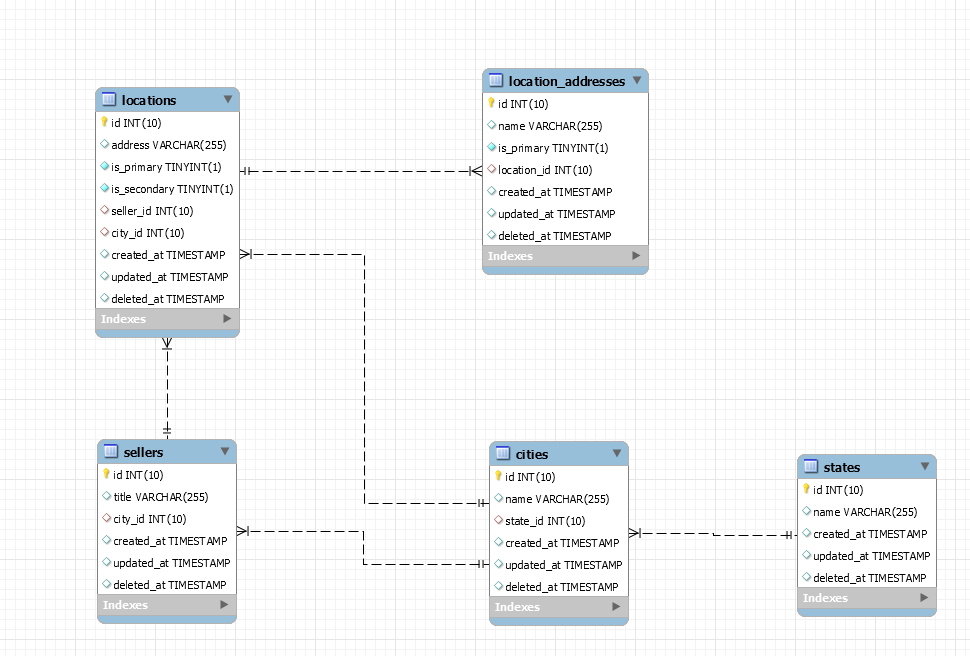
See action on real example
Database schema :
Models :
class Seller extends BaseModel
{
    public function locations()
    {
        return $this->hasMany(Location::class);
    }

    public function locationPrimary()
    {
        return $this->hasOne(Location::class)
            ->where('is_primary', '=', 1);
    }

    public function city()
    {
        return $this->belongsTo(City::class);
    }
class Location extends BaseModel
{
    public function locationAddressPrimary()
    {
        return $this->hasOne(LocationAddress::class)
            ->where('is_primary', '=', 1);
    }
class City extends BaseModel
{
    public function state()
    {
        return $this->belongsTo(State::class);
    }
}
Join
Join BelongsTo
Seller::joinRelations('city')
Join HasOne
Seller::joinRelations('locationPrimary')
Join HasMany
Seller::joinRelations('locations')
Join Mixed
Seller::joinRelations('city.state')
Join (mix left join)
Seller::joinRelations('city', true)->joinRelations('city.state', false)
Join (multiple relationships)
Seller::join(['city.state', 'locations'])
Ordering
Order BelongsTo
Seller::orderByJoin('city.title')
Order HasOne
Seller::orderByJoin('locationPrimary.address')
Order HasMany
Seller::orderByJoin('locations.title')
Order Mixed
Seller::orderByJoin('city.state.title')
Ordering (special cases with aggregate functions)
Order by relation count
Seller::orderByJoin('locations.id', 'asc', 'COUNT')
Order by relation field SUM
Seller::orderByJoin('locations.is_primary', 'asc', 'SUM')
Order by relation field AVG
Seller::orderByJoin('locations.is_primary', 'asc', 'AVG')
Order by relation field MAX
Seller::orderByJoin('locations.is_primary', 'asc', 'MAX')
Order by relation field MIN
Seller::orderByJoin('locations.is_primary', 'asc', 'MIN')
Filtering (where or orWhere)
Filter BelongsTo
Seller::whereJoin('city.title', '=', 'test')
Filter HasOne
Seller::whereJoin('locationPrimary.address', '=', 'test')
Filter HasMany
Seller::whereJoin('locations.title', '=', 'test')
Filter Mixed
Seller::whereJoin('city.state.title', '=', 'test')
Relation count
$sellers = Seller::setAppendRelationsCount(true)->join('locations', '=', 'test')
    ->get();

foreach ($sellers as $seller){
    echo 'Number of location = ' . $seller->locations_count;
}
Filter (mix left join)
Seller::joinRelations('city', true)
    ->joinRelations('city.state', false)
    ->whereJoin('city.id', '=', 1)
    ->orWhereJoin('city.state.id', '=', 1)
Generated queries
Query :
Order::whereJoin('seller.id', '=', 1)->get();
Sql :
select "orders".*
    from "orders"
    left join "sellers" on "sellers"."id" = "orders"."seller_id"
    where "sellers"."id" = ?
    and "orders"."deleted_at" is null
    group by "orders"."id"
Query :
Order::orderByJoin('seller.id', '=', 1)->get();
Sql :
select "orders".*, MAX(sellers.id) as sort
    from "orders"
    left join "sellers" on "sellers"."id" = "orders"."seller_id"
    where "orders"."deleted_at" is null
    group by "orders"."id"
    order by sort asc
Elegance of package
Lets look how first example from documentation now looks like. This code :
$posts = Post::select('posts.*')
    ->join('categories', 'categories.id', '=', 'posts.category_id')
    ->groupBy('posts.id')
    ->where('categories.deleted_at', '=', null)
    ->orderBy('categories.name');

if(request()->get('date')){
    $posts->where('date', $date)
}

$posts = $posts->get();
is now :
$posts = Post::orderByJoin('category.name');

if(request()->get('date')){
    $posts->where('posts.date', $date)
}

$posts = $posts->get();
Both snippets do the same thing.
Tests
This package is well covered with tests. If you want run tests just run composer update and then run tests with "vendor/bin/phpunit"
Contribution
Feel free to create new issue for :
- bug
- notice
- request new feature
- question
- clarification
- etc...
License
MIT
Free Software, Hell Yeah!
fico7489/laravel-eloquent-join 适用场景与选型建议
fico7489/laravel-eloquent-join 是一款 基于 PHP 开发的 Composer 扩展包,目前已累计 556.09k 次下载、GitHub Stars 达 341, 最近一次更新时间为 2017 年 12 月 17 日, 在 PHP 生态内属于活跃度较高的组件。
它主要适用于以下技术方向: 「laravel eloquent join」 「laravel sort join」 「laravel where join」 「laravel join relation」 「laravel join」 等业务场景。在实际项目中,围绕这些方向常见需要落地的问题包括:接口对接、性能调优、并发安全、与既有框架(Laravel / ThinkPHP / Yii / Webman 等)的兼容适配,以及生产环境的日志埋点与稳定性保障。
我们在过去多个企业项目中使用过 fico7489/laravel-eloquent-join 或与其功能相近的方案,如果你在选型或落地过程中遇到问题,例如 版本兼容、二次改造、私有化封装、与内部系统对接、生产 BUG 排查,欢迎联系我们协助评估。
基于 fico7489/laravel-eloquent-join 在你已有业务上做功能扩展、字段裁剪、UI 适配、与内部账号 / 权限 / 日志系统的深度对接。
线上偶发问题、内存泄漏、慢查询、并发异常等排查修复;针对高流量场景做缓存、队列、索引层面的调优。
承接完整的项目从需求 → 设计 → 开发 → 上线 → 长期运维;也可按月提供技术保姆服务。
与 fico7489/laravel-eloquent-join 相关的其它包
同方向 / 同关键字的高下载量 PHP Composer 包推荐,方便对比选型:
This package introduces the join magic for eloquent models and relations.
A Laravel Eloquent model trait for translatable resource
A package for automatically encrypting and decrypting Eloquent attributes in Laravel 5.5+, based on configuration settings.
Help to manage meta data on Laravel Eloquent model
A package to cast json fields, each sub-keys is castable
Twig filter that joins an array using a different separator for the last element
统计信息
- 总下载量: 556.09k
- 月度下载量: 0
- 日度下载量: 0
- 收藏数: 345
- 点击次数: 33
- 依赖项目数: 7
- 推荐数: 0
其他信息
- 授权协议: MIT
- 更新时间: 2017-12-17