psg/sr2
Composer 安装命令:
composer require psg/sr2
包简介
App Standardization
README 文档
README
composer require psg/sr2
class App implements Psg\Sr2\LayeredApp{}
Concepts
Types
- Beforeware : outerware for setting of configuration
- Frontware : middleware caring only about the front
- Middleware : regular middleware the wraps the core and other middleware
- Coreware : the core app logic that is wrapped by middleware
- Backware : middleware caring only about the back
- Afterware : outerware for doing things after the resopnse, like cleaning up

ExitResponseInterface
For Frontware to force a bypass, because it does not control the flow by calling next, it must return a special response implementing ExitResponseInterface. It does this through the app factory $app->createExitResponse, which is just like createResponse.
Request And Response Flow
The above diagram is an oversimplification. The reality looks more like this:
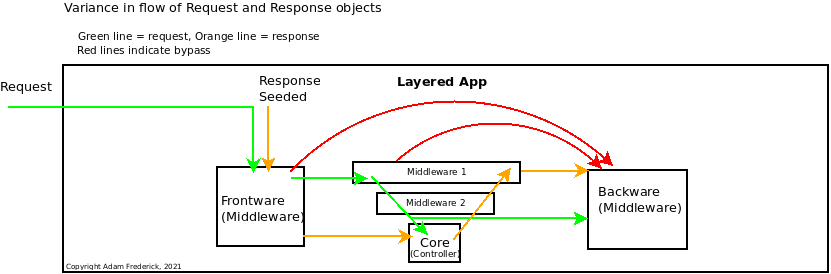
Here you can see that the response is forwarded to the core from the frontware.
Coreware
In Apps, there is an idea of a core which is usually called the controller. What is special about this core is that, regardless of what middleware is added during the running of the app, the core will always be executed at the core (whereas, where middleware is executed depends on the list of other middleware).
I decided to call this core instead of control to make it more generic (it also includes running view code).
I also decided to make this a single callable or {instantiable thing with an __invoke method}. In my implementation, I provide the callable with the parameters ($request, $response, $app). It is, however, expectable that frameworks will want to:
- inject parameters as necessary into the core call
- inject parameters into the __construct if the core is an instantiable As such, the parameters are left up to the framework.
Middleware, like a router, can set the core using $app->core($core). The $app->core() method sets this coreware, and will overwrite anything that exists priorhand as the core.
I decided that the coreware should not be multiple. Coreware is not expected to be generic, it is expected to be specific to the app, so a list is unnecessary.
There is the semblance of a conceptual issue about the has function. Since outerware is now present, and there is front and back specific middleware, what does has refer to?
Extension
Depending on demand and my free time, I will add events and container extensions, probably using the FIG PSRs.
Example
统计信息
- 总下载量: 9
- 月度下载量: 0
- 日度下载量: 0
- 收藏数: 0
- 点击次数: 0
- 依赖项目数: 1
- 推荐数: 0
其他信息
- 授权协议: MIT
- 更新时间: 2021-07-14