xdroidteam/xtrust
Composer 安装命令:
composer require xdroidteam/xtrust
包简介
Role and permission based rights for laravel
关键字:
README 文档
README
Contents
Key features
- You have roles and permissions. Permissions can be attached to a role, and roles can be attached to a single user, but also you can attach or detach permission/permissions from a specific user.
- Permissions and roles are stored in the cache, editing them automatically refreshes it. We use cache tags, so regular file or database cache drivers doesn't work, please use memcached instead.
- Inspired by Zizaco/entrust
- Please note, the package is under development, only tested with Laravel 5.2.
Installation
Add the following line to your composer.json (Laravel 5.4 and below):
"xdroidteam/xtrust": "0.1.*"
Add the following line to your composer.json (Laravel 5.5):
"xdroidteam/xtrust": "0.2.*"
Then run composer update.
or you can run the composer require command from your terminal:
composer require xdroidteam/xtrust
Then in your config/app.php add to the providers array (not needed after Laravel 5.5):
XdroidTeam\XTrust\XTrustServiceProvider::class,
and to aliases array (not needed after Laravel 5.5):
'XTrust' => XdroidTeam\XTrust\XTrust::class,
If you are going to use Middleware (requires Laravel 5.1 or later) you also need to add
'permission' => \XdroidTeam\XTrust\Middleware\XTrustPermissionMiddleware::class,
to routeMiddleware array in app/Http/Kernel.php.
Migration
Deploy migration file:
php artisan vendor:publish --tag=xdroidteam-xtrust
You may now run it with the artisan migrate command:
php artisan migrate
Models
Role
Create a Role model inside app/models/Role.php using the following example:
<?php namespace App\Models;

use XdroidTeam\XTrust\Models\XTrustRole;

class Role extends XTrustRole
{
  ...
}
Permission
Create a Permission model inside app/models/Permission.php using the following example:
<?php namespace App\Models;

use XdroidTeam\XTrust\Models\XTrustPermission;

class Permission extends XTrustPermission
{
  ...
}
User
Next, use the XTrustUserTrait trait in your existing User model. For example:
<?php

use XdroidTeam\XTrust\Traits\XTrustUserTrait;

class User extends Eloquent
{
    use XTrustUserTrait; // add this trait to your user model

    ...
}
Don't forget to dump composer autoload
composer dump-autoload
Concept
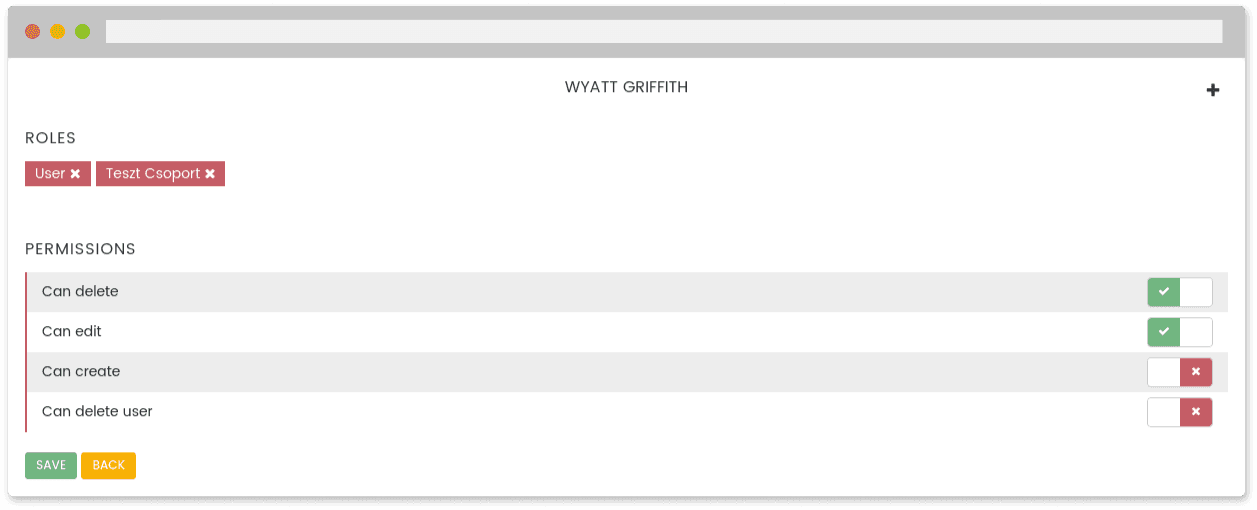
There are roles and permissions. You can attach many permissions to a role, and attach many roles to a user, like in Zizaco/entrust. The main difference, that you can directly attach or detach permissions to a user.
For example
You have four permissions:
- can_show
- can_create
- can_edit
- can_delete
You have two roles, with permissions:
- admin:
- can_show
- can_create
- can_edit
- can_delete
- user:
- can_show
You have two users, with roles:
- Adam Admin:
- admin
- Super User
- user
If you don't want Adam Admin, to be able to delete, you can simply detach the can_delete permission from him. The admin group can still have the can_delete permission, but Adam will not. If you want Super User to be able to edit, you can attach this permisson (can_edit) to her. The other users in the user role will still be unable to edit, except her.
Because of this logic, you can't check the user roles, only the permissions!
Example for UI:
Usage
Permission checking
Simple checking
Check one permission:
XTrust::hasPermission('can_delete');
Returns true, if the authanticated user has the permission, returns false if not.
Check multiple permissions:
XTrust::hasPermissions(['can_delete', 'can_edit']);
Returns true, if the authanticated user has all the permissions, returns false if not.
Or:
XTrust::hasOneOfPermissions(['can_delete', 'can_edit']);
Returns true, if the authanticated user has one of the permissions, returns false if not.
You can also check within the user model:
$user = User::find(1);
$user->hasPermission('can_delete');
// OR
$user->hasPermissions(['can_delete', 'can_edit']);
// OR
$user->hasOneOfPermissions(['can_delete', 'can_edit']);
Middleware
Route::group(['middleware' => ['auth', 'permission:can_show']], function(){
    Route::get('/', 'HomeController@index');
});
For multiple permission check use pipe symbol as OR operator:
Route::group([
	'middleware' => [
    	'auth',
        'permission:can_show|can_create|can_edit|can_delete'
    ]
], function(){
    Route::get('/admin', 'AdminController@index');
});
To emulate AND functionality just use multiple instances of middleware For multiple permission check use pipe symbol as OR operator:
Route::group([
	'middleware' => [
    	'auth',
        'permission:can_show',
        'permission:can_create'
    ]
], function(){
    Route::get('/admin', 'AdminController@index');
});
Blade
@permission('can_delete')
	{!! Form::open([
    	'url' => '/users/'.$user->id,
        'method'=> "DELETE"
    ] ) !!}
        <button class="btn btn-sm btn-danger">
            Delete
        </button>
    {!! Form::close() !!}
@endpermission
Multiple permissions:
@permissions(['can_show', 'can_delete'])
	<span>Something</span>
@endpermissions
Returns true, if the authanticated user has all the permissions, returns false if not.
Or:
@oneofpermissions(['can_show', 'can_delete'])
	<span>Something</span>
@endoneofpermissions
Returns true, if the authanticated user has one of the permissions, returns false if not.
Role checking
Simple checking
Check one role:
XTrust::hasRole('can_delete');
Returns true, if the authanticated user has the role, returns false if not.
Check multiple roles:
XTrust::hasRoles(['can_delete', 'can_edit']);
Returns true, if the authanticated user has all the roles, returns false if not.
Or:
XTrust::hasOneOfRoles(['can_delete', 'can_edit']);
Returns true, if the authanticated user has one of the roles, returns false if not.
You can also check within the user model:
$user = User::find(1);
$user->hasRole('can_delete');
// OR
$user->hasRoles(['can_delete', 'can_edit']);
// OR
$user->hasOneOfRoles(['can_delete', 'can_edit']);
Attaching detaching
Always use the the id of the role or permission for attaching/detaching!
Attach to a user
Attach one role to a user:
$user->attachRole(1);
Attach multiple roles to a user:
$user->attachRoles([1,2]);
Attach one permission to a user:
$user->attachPermission(1);
Attach multiple permissions to a user:
$user->attachPermissions([1,2]);
Detach from a user
Detach one role from a user:
$user->detachRole(1);
Detach multiple roles from a user:
$user->detachRoles([1,2]);
Detach one permission from a user:
$user->detachPermission(1);
Detach multiple permissions from a user:
$user->detachPermissions([1,2]);
Attach to a role
Attach one permission to a role:
$role->attachPermission(1);
Attach multiple permissions to a role:
$role->attachPermissions([1,2]);
Detach from a role
Detach one permission from a role:
$role->detachPermission(1);
Detach multiple permissions from a role:
$role->detachPermissions([1,2]);
xdroidteam/xtrust 适用场景与选型建议
xdroidteam/xtrust 是一款 基于 PHP 开发的 Composer 扩展包,目前已累计 8.79k 次下载、GitHub Stars 达 4, 最近一次更新时间为 2016 年 10 月 15 日, 在 PHP 生态内属于活跃度较高的组件。
它主要适用于以下技术方向: 「laravel」 「rights」 「role」 「permimssion」 等业务场景。在实际项目中,围绕这些方向常见需要落地的问题包括:接口对接、性能调优、并发安全、与既有框架(Laravel / ThinkPHP / Yii / Webman 等)的兼容适配,以及生产环境的日志埋点与稳定性保障。
我们在过去多个企业项目中使用过 xdroidteam/xtrust 或与其功能相近的方案,如果你在选型或落地过程中遇到问题,例如 版本兼容、二次改造、私有化封装、与内部系统对接、生产 BUG 排查,欢迎联系我们协助评估。
基于 xdroidteam/xtrust 在你已有业务上做功能扩展、字段裁剪、UI 适配、与内部账号 / 权限 / 日志系统的深度对接。
线上偶发问题、内存泄漏、慢查询、并发异常等排查修复;针对高流量场景做缓存、队列、索引层面的调优。
承接完整的项目从需求 → 设计 → 开发 → 上线 → 长期运维;也可按月提供技术保姆服务。
与 xdroidteam/xtrust 相关的其它包
同方向 / 同关键字的高下载量 PHP Composer 包推荐,方便对比选型:
Provide a way to secure accesses to all routes of an symfony application.
The library provides a flexible way to add role-based access control management to CakePHP 3.x
Yii2 User
A Laravel Nova tool for `ACL` based on `laratrust` package.
This plugin allows you to manage the rights and roles of administrator users
Menu and role management helper.
统计信息
- 总下载量: 8.79k
- 月度下载量: 0
- 日度下载量: 0
- 收藏数: 4
- 点击次数: 11
- 依赖项目数: 0
- 推荐数: 0
其他信息
- 授权协议: MIT
- 更新时间: 2016-10-15